A Practical Guide to Aerosol Particle Counter Matching
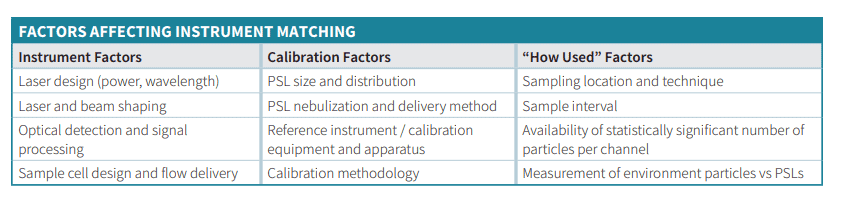
When adding new particle counters to an existing monitoring program, differences in reported counts can raise questions about instrument performance and data reliability. This paper explores why variations occur, how to interpret them, and what constitutes a meaningful comparison between aerosol particle counters. Readers will gain a practical understanding of expected data variation, the factors that influence particle counts, and how to make reasonable comparisons between similar and dissimilar instruments.
Differences in Aerosol Particle Counter Results
A common question related to aerosol particle counters is how well particle counting results should match each other. New airborne particle counters added to an existing fleet won’t always match the counts of the old. This could be as a result of different manufacturer’s, but even when the particle counters are supplied by the same manufacturer, it is not uncommon for variation to exist.
There are three common cases that provoke questions about data agreement between two aerosol optical particle counters:
- Group 1: Same instruments from the same manufacturer
- Group 2: Like instruments from different manufacturers*
- Group 3: Unlike instruments from same or different manufacturers
Relative Data Comparisons and Contamination Trending
Aerosol optical particle counters in Groups 1 and 2 should provide similar relative particle trend data over time. Cumulative, normalized counts are the most meaningful comparison, and common trend profiles, including stable counts, particle events, and clean-up curves following significant upsets, should align well. Count offsets of a factor of two or more may still be acceptable, particularly in lower ISO classes where steady-state particle levels are well below action limits.
Best practices suggest avoiding Group 3 for even relative data comparison because there are simply too many variables associated with the instrumentation that can lead to differences in the particle count data. Although this conclusion seems obvious, it is worth mentioning here because it does happen in the real world and these comparisons should be avoided.